







Destinations Archives – Page 5 of 16 – Crown Cruise Vacations
Viking Mississippi Riverboat to Start Cruising in August 2022
June 17, 2020 | Jackie Sheckler Finch
The first cruise I ever took was the 1976 inaugural tour of the Mississippi Queen. The paddle wheeler went from New Orleans to Cincinnati for my memorable voyage.
A favorite of cruisers, the Mississippi Queen was dismantled and sold for scrap in 2011. A sad loss for her many fans.
Kakaw Chocolate Factory Tour
June 10, 2020 | Jackie Sheckler Finch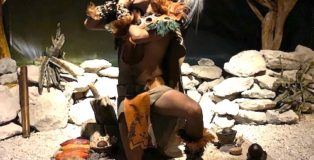
When a shaman wearing a loin cloth and feathered headdress welcomed us, we knew this was not going to be a typical museum visit.
It wasn’t. Our tour of Kakaw Chocolate Factory in Costa Maya, Mexico, was entertaining, informative and delicious. The three guides were excellent actors who seemed to delight in the characters they were playing – the shaman, Sister Rita the nun and Dr. Adamstein the mad scientist.
Patsy Cline Museum Showcases Recently Discovered Personal Items
June 3, 2020 | Jackie Sheckler Finch
Patsy Cline saved the memories of her life. That memorabilia, after being locked away for more than half a century, is now being seen at the Patsy Cline Museum in Nashville.
“Patsy Cline was very sentimental,” said museum founder Bill Miller. “I think people will be really surprised at what we have in the museum.”
Explore Dali’s surreal dreams at unusual Florida museum
May 6, 2020 | Jackie Sheckler Finch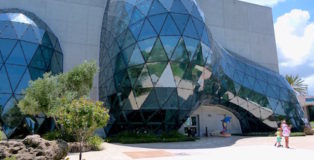
The shifting landscape beneath me seems to be pulling me down into its clutches. Creatures with tall spindly spider legs and long elephant trunks gallop across the horizon.
Alice Cooper appears from nowhere. Wait – was that really the shock rocker? What is Alice Cooper doing in my dream?
Tower of London a forbidding structure
April 2, 2020 | Jackie Sheckler Finch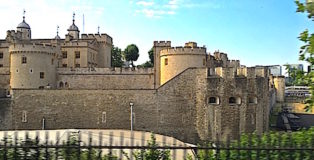
Even the sun seemed to hide when we walked into the Tower of London.
A clear blue sky suddenly darkened and a quick wind ate through my summer shirt.
“It must have been miserable here in the winter,” a fellow traveler said, as we tried to walk a little faster.
S.S. Legacy is ‘green’ ship to reduce footprint on nature’s beauty
January 30, 2020 | Jackie Sheckler Finch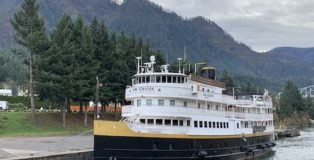
Two aluminum water bottles are lined up on the desk in my cabin. Cloth napkins on the dining table take the place of paper. No plastic straws. No Styrofoam or plastic cups are used on this vessel.
A daily menu is printed and attached to a frame in the dining room entryway. Daily itineraries are on a bulletin board and on a scrolling video screen so that paper use is minimized. Recycling efforts are everywhere.
Louis Armstrong: From Street Waif to Music Legend
January 16, 2020 | Jackie Sheckler Finch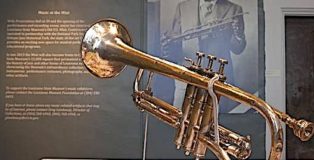
On New Year’s Eve in 1912, a young New Orleans boy fired a gun into the air. That was a big mistake – or maybe it was a huge break for the child and for the world of music.
Arrested for disturbing the peace, Louis Armstrong was sent to the Colored Waif’s Home in New Orleans. While there, he met band manager Peter Davis and received his first formal music training.
Washday meal still a tradition in New Orleans
December 26, 2019 | Jackie Sheckler Finch
Before the advent of modern washing machines, many women set aside Monday for the weekly chore of washing and drying the family laundry. At the same time, they would need to plan a hearty supper.
“What they did,” said Debbie Kelly, “is cook something that wouldn’t need a lot of attention, something they could put on the stove and it would be ready at the end of the day.”
New Orleans hurricane exhibit packs powerful punch
October 1, 2018 | Jackie Sheckler Finch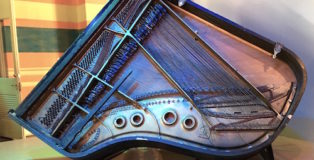
By Jackie Sheckler Finch
Scrawled on well-worn blue jeans are a man’s name, social security number, blood type, wife’s name, hotel where she was evacuated for safety and the hotel phone number.
Claudio Hemb wanted to ensure that his body would be identified and his family notified if he perished in Hurricane Katrina’s floodwaters.
“Seeing all these things is horrifying,” says Margaret Thompson of Atlanta. “I saw it on the news but this museum just touches my heart and soul.”
The exhibit, “Living with Hurricanes: Katrina and Beyond” at the Louisiana State Museum in New Orleans’ French Quarter, brings home the devastating power of hurricanes. Located on Jackson Square, the museum is a popular stop for riverboat passengers when they embark or disembark for their cruises.
Hurricane Katrina in 2005 and the aftermath flooded 80 percent of New Orleans and took an estimated 1,500 lives.
“We knew right after the storm that we had to collect artifacts because we were going to do this exhibit,” says Karen Leathem, museum historian. “It was such a significant event, not only for us but for the entire state and for the nation as well.”
Although the catastrophe was precipitated by a natural event, “it was really a human-made disaster,” Karen says. “We wanted to explain why it happened and what we need to do to make sure it never happens again.”
Somber exhibits share personal tragedies
Opened in October 2010, the permanent exhibit greets visitors with a powerful emotional punch beginning with the lobby of the circa 1791 Presbytère building. Originally the residence of Capuchin monks, the Presbytère became part of the Louisiana State Museum in 1911.
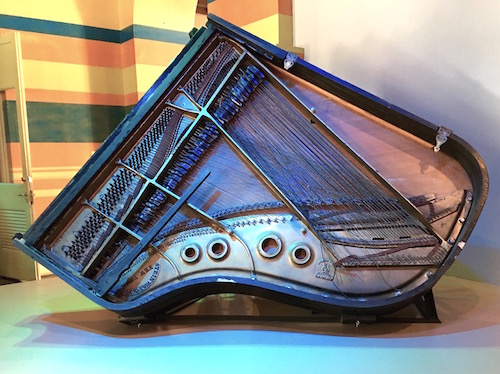
Positioned exactly as it was when floodwaters destroyed his home, a ruined Steinway baby grand piano that belonged to legendary New Orleans musician Fats Domino is a lobby centerpiece. For days after Katrina hit, people feared the rock-and-roll pioneer had died when his Lower Ninth Ward home was flooded to the roof.
A well-known homebody, Fats Domino and his wife Rosemary didn’t evacuate before the hurricane but were later rescued by boat and taken to a shelter in Baton Rouge. Almost everything the couple owned was lost. Fats Domino died Oct. 24, 2017, at age 89.
Colored stripes on the museum lobby walls depict water levels reached by the rising waters. Standing beneath the lines is a stark reminder of how people became trapped and drowned.
The ceiling is hung with hundreds of glass bottles filled with notes in homage to those who perished. Blue glass hands interspersed among the bottles honor volunteers who came to the city to help in the rescue and rebuilding.
Four galleries inside the museum contain artifacts, dramatic footage and interviews with survivors. In the first gallery, visitors learn the geographical facts about living in a city that is below sea level and surrounded by water.
Katrina’s fury felt in museum exhibits
Visitors move through an Evacuation Corridor overhearing residents’ voices weighing options as Katrina approaches. A state-of-the art Storm Theater shows Katrina’s full fury with dramatic footage of the hurricane onslaught.
Gallery Two takes visitors past a leaking floodwall and into an attic and onto the roof of a house surrounded by rising floodwaters. When his family evacuated to Houston as Katrina bore down on New Orleans, Claudio Hemb stayed behind to secure his French Quarter business.
The day after Katrina devastated the city, Claudio set out on bicycle to reach his Lakeshore home about seven miles away, inking vital info on his pants in case he didn’t make it. Fortunately, he did.
Framed in a glass shadow box is a hatchet that a mother and daughter bought two days before Katrina. Trapped in the small attic of their St. Bernard Parish home, the two used that hatchet to chop through the roof to be seen and rescued by boat.
“What would have happened if they hadn’t bought that hatchet?” asks Carolyn Miller of Louisville, Kentucky. “They couldn’t have clawed their way out of that attic without the hatchet. They probably would have died in there. It gives me shivers just to think about it.”
On the “Mabry Wall,” housing complex resident Tommie Elton Mabry wrote on his apartment walls with a black felt tip marker to record his ordeal starting with the day before Katrina hit and continuing for weeks afterward. Museum staff preserved his journal before the building was demolished.
A mud-encrusted teddy bear illustrates the personal possessions that were lost and the hope that former owners of those beloved items survived the catastrophe. A garage door shows the markings of rescuers who note that two cats and one dog were found dead inside.
“Do not remove. Owner will bury,” says a red painted message.
Disaster relief was slow in arriving
Seats from the heavily damaged Louisiana Superdome are a reminder of where an estimated 35,000 people sought refuge and rescue.
“The number of people combined with the stifling heat and the breakdown of plumbing systems created notoriously miserable conditions as the sports stadium came to symbolize failed emergency response systems,” a placard notes.
Gallery Three explains the forensics of Katrina and shows through digital animation how the levees failed. “The levees failed because of poor design and poor construction,” Karen says. An estimated 70 percent of New Orleans occupied housing was damaged by Katrina.
Gallery Four deals with recovery and promotes preparedness. “Seeing what happened here brought up discussions on how disasters are handled,” Karen says.
“Disasters happen around us all the time,” she concludes. “We need to know how to manage disasters and also what we should be looking for from our local government.”
Photo by Jackie Sheckler Finch
1. Fats Domino’s piano is displayed exactly as Katrina left it.
Shore Excursion: How Bora Bora got its name, having a cold drink at Bloody Mary’s
October 11, 2017 | Jackie Sheckler Finch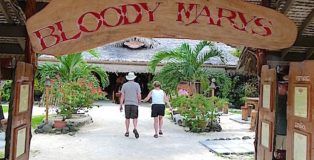
If Captain Cook hadn’t misunderstood what the French Polynesians were calling their home, the island of Bora Bora might have a different name today.
That’s a tidbit I learned from tour guide Sandra as we bounced around the popular island in our open-air “Le Truck” vehicle.
Known as “Romantic Island,” Bora Bora was originally named Pora Pora which means “First Born.” Legend says this was the first island to rise when the supreme god Taaroa fished it out of the waters.
“When Captain Cook came here, he thought the Polynesians were calling it Bora Bora,” Sandra said. “The letter ‘B’ does not exist in the Tahitian language so he mistook the softened sound of the Tahitian ‘P’ for a ‘B.’ They were really saying Pora Pora.”
Bora Bora consists of three main villages with a population of about 9,500, most of whom live on the coast. The main road skirts around the island shore line and is about 19 miles long. In the center of Bora Bora are the remnants of an extinct volcano, which has two peaks, Mount Pahia and Mount Otemanu.
Today, the Island of Bora Bora relies largely on tourism and boasts several luxurious resorts with very expensive prices. “Bora Bora was the first to build bungalows that stand over the water using stilts,” Sandra said. “These are so popular with tourists that other places started building them.”
As we bumped along the road in our tourist truck, Sandra pointed out some of the water bungalows, saying this one was where Leonardo DiCaprio stayed and that one was Marlon Brando’s until he bought his own private island.
The main languages on Bora Bora are French and Tahitian but English is also spoken in hotels, markets and other tourist locations. The pace is laid back and relaxing with the philosophy being “aita pea pea” which means “not to worry.”
We didn’t stop but drove by a ramshackle old World War II military base where the bunkers are slowly fading into the jungle. When Pearl Harbor was attacked, the U.S. military used Bora Bora as a supply base and built defenses along the coast to protect the island against a possible surprise attack by Japan.
Seven huge cannons are scattered across the landscape, quietly rusting in the island sun. Each of the guns is over 20 feet long and mounted on a swivel base.
“The military also built the coastal road on the island and Bora Bora’s first airport in 1943,” Sandra said, adding that the Motu Mute airport is still used today.
Luckily, no combat took place on Bora Bora. The U.S. military base officially closed on June 2, 1946, although it is said that some American soldiers decided to stay on the island rather than return to their homeland.
Arriving at legendary Bloody Mary’s, we were greeted by huge billboards printed with the names of celebrities, athletes, politicians and others who have visited the Bora Bora landmark. The boards were on both sides of the entrance and must have contained hundreds of names.
I’ll drop a few of them – Billy Idol, Charlie Sheen, Steven Tyler, Rod Stewart, Johnny Depp, Keanu Reeves, Janet Jackson, Goldie Hawn, Kurt Russell, James Michener, Sen. John McCain, Harrison Ford, Ringo Starr, Sean Penn, astronaut Buzz Aldrin, Diana Ross and many many more.
Established in 1979 as a small five-table restaurant, Bloody Mary’s is named for a character in James Michener’s 1946 book “Tale of the South Pacific.” The book was the basis for the musical “South Pacific” which was later made into a film in 1958 and in 2001.
The daily catch of local fisherman is a specialty on Bloody Mary’s dinner menu. Most requested drink, not surprisingly, is the spicy Bloody Mary cocktail of vodka and tomato juice served at the bar which looks like a thatched hut. Instead of a coat check, Bloody Mary’s has a shoe and sandal check. The floors are covered in sand making you feel as though you are walking on the beach.
Handcrafted tables and chairs are made of wood. One long wall of the open-air restaurant is covered with autographed and dated dollar bills plus other paper currencies from around the world. Since public transportation does not exist on Bora Bora, the restaurant offers a complimentary shuttle.
As we climbed back aboard Le Truck, the Rogers and Hammerstein song from “South Pacific” – “Some Enchanted Evening” – kept running through my mind.
This whole visit to French Polynesia has been enchanted. And it has passed so quickly.
Photo by Jackie Sheckler Finch


View Recent Comments